Category Archives: Brilliant

Brian Eno

20130513-132256.jpg

Brian Eno gave a lecture at the Red Bull Music Academy recently. I just watched it this morning and now have a small checklist of things to do / listen to, an app to download, and a workflow to get going. I read his excellent, insightful 1995 diary, ‘A Year With Swollen Appendices’ about ten years ago and have always been impressed by him.

Here’s an excellent summary of the lecture by someone who was actually there, Una Mullally.

Sherbet lemon?

20130409-144503.jpg

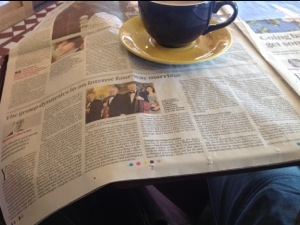
I’ve been a subscriber to The Irish Times for about six months now (it is delivered imperceptibly every morning, waiting for me on the front step when I come down). One of the very great things about it is the variety and scope of the writers. Reading them week after week, you get a sense of their personality (the norm now of putting the writer’s picture at the top of the article helps, too). I read a lot of international news media on the Internet, too, but it doesn’t compare to leafing through the paper over a cup of coffee, casting one’s eye over the properly full-sized pages, reading the odd thing that jumps out. For example, Michael Dervan is the grandmaster of music criticism in Ireland — towering in stature and in intellect — so I had to read twice the following charmingly Dumbledore-ish sentence in his column today:

In its lowest range [the double bass] is utterly unique, rich and soft-textured in a way that makes you smile and want to rub your tummy.

He describes the new film, A Late Quartet, too (about the complicated relationships between the members of a professional string quartet), which sounds very good. (Philip Seymour Hoffman and Christopher Walken?! — albeit, as it transpires, senza vibrato…)

Going to a concert

20130327-100114.jpg

Tonight I’m bringing half a dozen of my piano students to hear Benjamin Grosvenor’s piano recital at The National Concert Hall. For many of them it’ll be their first time at such an event. I don’t know a great deal about Mr Grosvenor (although he’s probably weirded out by people calling him Mr Grosvenor), other than that he’s a phenomenal pianist, a prodigy, a wünderkind.

I showed some of my students a YouTube video of an 11-year old Benjamin performing with astonishing maturity in the final of the BBC Young Musician of the Year back in 2003. Tonight, his programme consists of transcriptions of Bach, some Chopin (including the Op. 22 Andante Spianato and Grande Polonaise), Scriabin, Granados, and ending with a virtuosic arrangement of Strauss’s Blue Danube. Here’s a Spotify playlist I put together of the pieces. One of the Bach pieces I couldn’t find and one I could only find in its original solo violin form (but I’ve included it anyway).

I’ll let you know what we all think 🙂

The book in the picture, by the way, is something I found in a charity shop (possibly The Secret Bookstore on Wicklow Street). First published in 1950, it’s full of entertainingly unapologetic opinions such as:

A word about the habit of giving bouquets at concerts. You will see it both at star recitals and, sometimes, at recitals by new artists. It’s silly really, and as it’s perfectly obvious that the flowers are sent in by friends or, in the case of young artists, by proud relatives, it deceives nobody into thinking any the more of a performance. It was, I think, Bernard Shaw who pointed out the impossibility of an audience offering spontaneous tributes, and who referred ironically to the custom of well-bred people of always taking a bouquet with them to a concert on the off-chance of wanting to present it!

Watch Low perform ‘Waiting’ for Best Fit

Watch Low perform ‘Waiting’ for Best Fit.

One of my very favourite bands. I first heard them when I was at university in Edinburgh and an artist friend, David Martin, asked me what I wanted for Christmas. I asked for Low’s ‘Christmas’ album, that I’d read good things about. They way they write and, crucially, the beautiful way they perform, impacted me greatly.

I saw them play in Dublin’s Christ Church Cathedral a few years later, and have seen them a couple of times since. Mesmerising.

This video is beautifully shot, portraying the distillation that comes across in their work. The shelves of books, learning, curiosity, filtered through these human beings into such plain-spoken, finely-wrought music.


Albert Herring

Firstly, delighted with myself: I completed the Crosaire crossword in The Irish Times today, most of it in less than an hour as I ate my dinner. One of the very last ones I got was rather nice.

Most uninhibited sort are confused by thief dropping farthing on road (9)

If we ‘confuse’ the letters of the word ‘are’ we get EAR…if we ‘drop’ the abbreviation of farthing (F) from thief we get THIE…and road=street=ST. All that gives us our answer: EARTHIEST (“most uninhibited sort”).

I’ve started working with a young singer/songwriter called Laura Elizabeth. I’ll be doing some playing on recordings she’s planning to make in the next while. Definitely one to watch — I’ll keep you posted. Check out her videos on YouTube.

This evening I went to the Royal Irish Academy of Music’s production of Albert Herring, an opera by Benjamin Britten. It was brilliant. The staging, for a start, was really economically managed, but pleasantly fulsome to set the scene in the happily bustling rural English town. The grocer’s boxes are full, the tables for the May Fair groan with delectable treats. Scenes were changed fluidly, only once requiring crew to come onto the stage. Costumes were a treat — Margaret Bridge as the imperious Lady Billows was gloriously bedecked in sartorial finery (to match her superb singing). Her sidekick, Florence Pike, sported an ominous eyepatch and self-important tweed skirt and jacket. The school mistress, the mayor, the young buck Sid, his sweetheart Nancy, the three kids, Albert, and his mother; all these characters were dressed in the colourful and elegantly practical clothing of an idealised inter-war England. The local policeman and vicar (played outstandingly by Padraic Rowan) wear the uniforms of their stations.

It’s a fairly evenly-distributed score, with everyone getting their chance to shine. Particularly impressive are the ‘crowd’ scenes and one ensemble that comes to mind is the one in the grocer’s in the second act. Mrs Herring and Nancy are joined by the octave-apart unison of the vicar and the school mistress (who, in the tradition of Oscar Wilde’s Dr Chasuble and Miss Prism, seem to have un petit frisson between them) — those pillars of society enveloping the fretting mother and guilt-ridden friend with stoic music. One part that feels underwritten is the mayor, a tenor role that doesn’t seem to add much to the drama. When given the podium at the May Fair to honour the newly-crowned Albert, he goes off on a self-aggrandising tangent about his council’s past achievements. Perhaps a bit of social commentary is being made…?

Britten’s music is wonderful. I’m not familiar with most of his operas, but those I have seen have convinced me that his reputation as a master of the genre is thoroughly deserved. This one, in particular, seems to be a great choice for a university level cast of the calibre of the RIAM singers. The music is supremely challenging for vocalists and orchestra, but marvellously engaging for an audience. What a delight to have such operas in English! I’m looking forward to the next one already.

A old friend of mine, Conor Mitchell, is one composer who is doing brilliant work. I went to see his opera ‘The Musician’, based on the story of the pied piper, in Belfast a few years ago and was blown away by how good it was. He just completed a set of Cabaret Songs to texts by WH Auden and Mark Ravenhill, which will be performed at Britten’s centenary celebrations in Aldeburgh later this year.

Crosaire No 14,970 (and Tim Garland)

Completed most of this one quite quickly last night and finished it this morning. But for two clues:

16d Rank fellow with you close to messy room (= FUSTY)

I actually had _UST_, and my mother impressed upon me at a young age the usage of ‘sty’ to mean a messy room. ‘You’ equating to U is a commonplace device, but I just didn’t cop ‘fellow’ as being F. As in FRA (Fellow of the Royal Academy). I got sidetracked with thinking that ‘rank fellow’ referred to a person of rank. ‘Rank’ here is, of course, the definition.

The other I missed was 24 down:

Come in for the end of the traffic light (= UNDERGO)

I got that ‘GO’ is the traffic light, and (with the benefit of the answer in front of me) that something one ‘comes in for’ – like criticism – is something that you ‘undergo’, but I don’t immediately get how ‘under’ is used for ‘the end of’.

Anyway, quite chuffed to get all the rest. Excited to get cracking on the Christmas Crosaire over the holiday.

Happy Christmas 🙂

PS Listening to an album called ‘Rising Tide’ by saxophonist Tim Garland recorded in New York in 2002. We saw him in the Queen Elizabeth Hall in London a few years ago with a band that included the two amazing players who play with Garland on this, Geoffrey Keezer on piano and Joe Locke on vibes & marimba. There are a couple of pieces, the long-form work ‘Sonata’ and the (regular size!) ‘Fantasy’ that feature a string quartet. ‘Sonata’ was, according to the liner notes, written for author Paulo Coelho. All beautifully inventive and with the ‘tonality dial’ at just the level I like! Some of the vibraphone runs are just breathtaking – check it out 🙂

The Dark Knight Rises

Such an enjoyable film! These are just some scattered thoughts.

This most recent take on the Batman story by director Christopher Nolan has been characterised by its brilliant baddies. A deep-seated desire for revenge fuels every one of the characters who rise above the throng of Gotham to engage in the struggle for its soul, and deception is very much the weapon of choice.

Despite having seen promo shots of Anne Hathaway in a catsuit, I was still delightfully surprised at her deft handling of the mask of Catwoman’s character. Gone is the weirdness and slight supernatural flavour given to the character Michelle Pfeiffer so memorably embodied. Here is a truly suitable partner for Bruce Wayne.

Perhaps it’s just my overactive crossword cortex, but I wondered at the link between her name, Selina Kyle, and the apt adjective ‘slinky’!

Bane was amazing. A true monster, right down to his buried heart. The tenderness with which his mask is repaired by the object of his affection was beautiful.

A few musical things stood out. The music that plays at Miranda Tate’s charity benefit (to which Bruce Wayne and Selina Kyle dance) is Ravel’s gorgeous ‘Pavane pour une infante défunte’, which translates as ‘Funeral music for a dead princess’. Later in the film, we learn just how much the death of a princess has brought about Gotham’s apocalypse.
There is a great moment, as Bruce Wayne fails in his second attempt to escape his prison, when the tensely pulsing strings suddenly chug to an embarrassed slower tempo. An extremely satisfying musical joke, pitched perfectly, as was all the humour in the film. (Sweeping generalisation, perhaps…your thoughts?)

Lovely reappearance by Cillian Murphy, who gets a great line as he pronounces sentence on an unfortunate victim. The hint of scarecrow in his costume was bang on.

One last thing I noticed was how the timescale of this trilogy is believable. There aren’t endless villains, nor is there endless time. A man – for that is what Batman is, after all – has but a short time to live. As remarkable as Bruce Wayne’s physical transformation is during the course of the film, he is not superhuman. There is a limit to personal vendetta. But, as this Olympic year has shown us, there is always a fresh generation of achievement, a fresh hunger to carry the ancient fire of the gods.