I played my best for him (pah rumpah pum pum)

Jonny Boyle sent me a link to this story about Joshua Bell (one of the world’s most highly acclaimed violin players). Have a quick read and come back to me…

I spent the last three months busking in Melbourne, sometimes – like Mr Bell – in a subway. I can empathise entirely with the story. My guitar isn’t worth 3.5 million, for example, but a significant number of people commented on the fact that I was busking with a quality instrument. I usually replied that it was the only guitar I owned, so I had no choice. If their objection was that one shouldn’t play a really good instrument on the street, I disagree. I also never once felt unsafe, but I realise that a sense of personal safety is rather subjective.

The best advice I got from fellow buskers was to persevere. Joshua Bell did really well getting $32 in forty-five minutes. It’s a fascinating social dynamic that’s at play and one of the things buskers commonly think about is whether or not to ‘seed’ their open guitar case or hat with a few coins to encourage people. I, rather obstinately, used to mostly start with nothing in the case. The amount of times I wanted to shout for joy at the first person to chuck something in!

I could probably count on one hand the number of people who stopped to listen. (I’m not counting the patient people in cafes or in open-windowed apartments who were within earshot of my chosen spots.) The reason I favoured the subway was the great acoustics and the fact that I had people’s aural attention for the duration of their walk from one end to the other. Unless they were on the phone, of course, in which case I’d either sing louder or exaggeratedly softer, depending on my mood.

Always, though, I played my very best for them and it felt wonderful. Thank you, Melbourne πŸ™‚

Not me, obvs, but you get the message...


Singing with Sting

The story – told rather breathlessly when I got home – of my impromptu jam with Sting in the subway of Flinders Street station in Melbourne.

PS You can see the pictures on Jenny’s Flickr site. Thanks to Jimmy Mulkens and Dominic Miller for sending me these shots, which I will treasure.

Steve Reich talks about composition

This lovely little video appeared on Twitter today. It’s by the London Sinfonietta, who are soon performing Steve Reich’s ‘Music For 18 Musicians’ with the composer.

It’s really a video programme note – Reich explains the genesis and history of the piece and describes the compositional method and instrumental choices he made. We also see the musicians rehearsing, of course.

Performing groups – and not just those with the clout or resources of the London Sinfonietta – would do well to embrace this model. Imagine travelling to a concert and watching tailor-made videos on the train that feature the players you’re about to see explaining the music you’re about to hear.

Australian folk songs

I wanted to learn some Australian folk songs while I was here and found a book in the music library where I was volunteering that seemed just the thing: ‘Folk songs of Australia and the men and women who sang them’, written by John Meredith and Hugh Anderson in 1967.

This is from the introduction to the book:

Each piece included, to some degree, fulfills the definition of John Meredith that a folk song is one composed to describe some happening or some aspect of the life of the singer, or of someone near to him, and ‘written purely for the purpose of self-expression or commemoration’. For these reasons the compilers have been at some trouble to surround and enrich the items by extensively quoting reminiscences, by including details of source, and by introducing the necessary background material. In this way it is hoped that the songs will glitter like rough diamonds in a suitably natural setting.

I wanted to choose a couple of songs to record and thought of working out some accompaniment for them on the guitar but, as the authors note in the introduction, “…of the hundreds of items forming the basis of this book not one tune was played upon nor a single song accompanied by a fretted instrument.”

The two songs I’ve recorded are perhaps not the most indicative of the general content of the book, but my main criterion was finding good melodies that I hadn’t heard before and these areΒ the ones that stood out to me.

(There are further short notes and lyrics for each song on my YouTube channel.)

Wonderwall

Here’s a friend of mine, Jonny Boyle, working his magic on ‘Wonderwall’ by Oasis. There are some other lovely instrumental gems on his YouTube channel – subscribe for sporadic surprises πŸ™‚

01 and 10

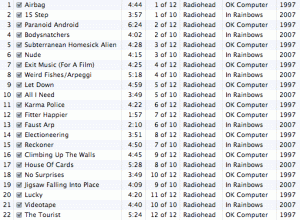
I’m listening to the Radiohead 01 and 10 playlist. The conspiracy theory behind the mashup between OK Computer and In Rainbows is an internet legend and actually rather compelling. I don’t really buy it, though. It’s not really amazing that the earlier album complements the latter in sound and message. I do accept the rather pleasing decaphilia that seems to pervade In Rainbows but I simply don’t believe that the two albums were ever meant to be heard together. The fact that they sound awesome together is all the more wonderful, then.

I first listened to the playlist without the 10-second crossfade recommended by some of the initiated. I figured that a band like Radiohead, who famously eschewed their record label and feel ambivalent at best towards the idea of corporations etc., would design something that required an iTunes feature to be fully appreciated. (Insert your preferred proprietary software if you like, but you get my point.) I’m listening to the crossfaded version as I write this. Alarm bells ring for me when the lovely, fitting, shudder-to-a-halt ending of ‘Paranoid Android’ is obliterated by the next track starting. It’s just not an enhancement of the art. Other segues between the tracks just sound like crossfades to me. Adjacent songs are in different keys and my ear recoils a little when they’re mashed together.

It’s a great, great idea, however, and I’m looking forward to a day when a band releases an album that does sound coherent when the tracks are rearranged and crossfaded in a particular way. That’ll be exciting; this playlist ain’t it, though.

What the 01 and 10 playlist does demonstrate, though, is the remarkable music of the Oxford band called Radiohead. Listening to the tracks in an unfamiliar order, harkening closely to the ending of one track and the beginning of another, attending to the lyrics, amazed me anew at the gift to the world that their music represents. Complex, yet often irresistably danceable (yes, I’m listening to Weird Fishes/Arpeggi at this moment…), sometimes heartbreaking, sometimes joyous.

My main aural observation was that the guitar lines are absolutely vital to what makes the songs brilliant. (More so in OK Computer – the interim period of experimentation saw the band explore a wider palette of instrumental possibilities.) The music, especially on the later album, is often truly contrapuntal, instruments and voice(s) twisting together without a reliance on chordal parts to underpin the texture. (It’s interesting that one of their most chordal songs, ‘Karma Police’, disintegrates into the unforgettably chilling ‘Fitter Happier’, almost as if they already knew at that stage that such songs were no longer going to be possible as their musical horizons expanded.) I’ve always especially loved ‘Electioneering’ from OK Computer, and it was listening to the fretboard-spanning guitar line that runs through the chorus that really alerted me to how important such discernable, often singable parts were to the band’s sound and musical vision.

So, my recommendation: read (a bit) about the idea behind it, put together the 01 and 10 playlist (sans crossfade), plug in a good pair of headphones and enjoy the music of one of the world’s very best bands from a fresh perspective. Then let me know what you heard.

The King’s Speech

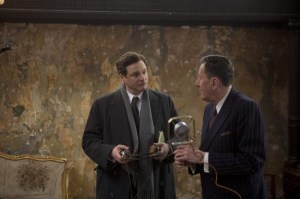
Colin Firth and Geoffrey Rush in 'The King's Speech'

I really enjoyed this film – we watched it today in the swanky Palace Brighton Bay cinema. It was interesting to watch it in Australia, having spent half a year here now. There are lots of amiable nods to Australia in the film (Lionel Logue, the speech therapist who helped King George VI and who is portrayed wonderfully by Geoffrey Rush in the film, was Australian).

The music in the film is rather prominent and matches the large-scale story well. To accompany Bertie’s first session with the antipodean therapist – as he roars the “To be or not to be” speech – it is Mozart’s ‘Marriage of Figaro’ overture that is blasted into his headphones to prevent him hearing himself. At the climax of the film – when the now King, George VI, is broadcasting his “In this grave hour” speech to his nation and empire – it is that most regal of music, Beethoven’s seventh symphonic slow movement, that provides the backdrop for the weighty words.

This seems to me a well considered and appropriate use of music. A noticeable part of the film’s ‘look’ was in recreating the clean, sparse furnishings of the time (and I mean furnishings in the widest sense: the clothes and the civic spaces as well as the dwelling decoration all harked back to a less cluttered time). Music composed especially and therefore unknown would have seemed trite and perhaps hackneyed in the context of such an aesthetic. As it was, the familiarity of the music gave it both a suitable gravitas and a cultural transparency.

It was the pitch-perfectness of these moments that allowed the film’s real charm and mischevious humour to shine all the brighter.

performance, teaching, composition & reviews