Category Archives: reviews and reports

Superbos!

'Called' - Bruce Herman (click for article about the artist)

Last night was the performance of Bach’s Magnificat and it was such fun. We met at the concert hall at 4.15 and went through the programme with the organist and the orchestra. We stood on the stage (five rows, I think it was, of about twenty-four singers each). In front of us were the orchestra — it’s quite a small band: double bass, cello, bassoon, chamber organ continuo, oboe/cor anglais, two flutes, triple strings (as far as I can recall) and timpani. Also not forgetting the trumpets that play such a great part in the outer movements. The choir is in five parts and there are five soloists, too, each of whom gets a solo aria.

The instruments are all given a moment to shine, too. I love the ‘Esurientes implevit bonis’ (the text of which translates as “he has filled the hungry with good things and has sent the rich away empty”) — it features a flute duet obbligato (music-speak for the fact that they play all the way through, as importantly as the vocalist) that at times trips along in thirds or sixths, and at times has the two lines tumbling over each other. Bach plays a little joke with the words at the end: the flutes stop short of the final note, leaving it to the bass instruments. Sending us away empty.

Bach dissects the text of the Magnificat (the song that the writer of Luke’s gospel ascribes to the awestruck teenage mother of God), making twelve separate movements. I was at a talk during the week by theologian Terry Eagleton and he mentioned that the lines I quoted above sound like a political chant — the sort of thing that crowds would’ve shouted in protest against a corrupt and oppressive ruling class, say.

Another musical joke (a traditional one — Durrante does the same thing in his setting of the Magnificat, which we also sang in the concert) is the use of the same music at the end of the piece as the start. The last line of the doxology (Glory be to the Father, and to the Son, and to the Holy Spirit. AS IT WAS IN THE BEGINNING, is now, and ever shall be, world without end, Amen.) lends itself nicely to the musical task of recapitulation (music-speak for having the first tune come back at the end). And what an ending it is! All trumpets (one of them a wee piccolo trumpet, playing gloriously high, piercing through the bustling music with a high, descending chromatic line. It’s as if, for a moment, we catch sight of something amazing before getting on with the business of jubilation.
Grace and poise

This weekend, New Dublin Voices took part in a production of ‘Singin’ In The Rain’ at the National Concert Hall. It was a full week of rehearsals starting with the conductor, John Wilson, putting us through our paces on Monday evening before we went along to the full orchestral rehearsals during the week. It was a wonderful experience—I really enjoyed sitting beside the bass clarinet player, having done a lot of orchestral clarinet playing in university. Being inside the orchestra was great. John Wilson reconstructed the score, the original having been tragically consigned to landfill many years ago. (In an article I read in Classic FM magazine with John, he also sadly notes that a lot of the music libraries of the big studios were destroyed. There was nothing for it but to literally write it all out again. It must’ve been a mammoth task!) The RTÉ Concert Orchestra were augmented with a rhythm section (piano, guitar, bass, drums) and, behind us on stage, a full saxophone section. They had some really lovely moments in the score, providing that close-harmony sound that only saxes can do. Seriously, it was a real treat sitting in the middle of it all and watching the realisation of this sublime music.

Here’s the sequence from the film for ‘Moses Supposes’, which the amazing dancers did pretty much step-for-step at the NCH:

A couple of my friends posted links to this video, too. Jaw-droppingly good. Danny Macaskill is to a trail bike what Gene Kelly is to tap shoes.

4 in a Bar

I supported the barbershop quartet, 4 in a Bar, at their CD launch at The Workman’s Club on Wednesday. I did my three best Sting covers: ‘Roxanne’, ‘Seven Days’ (with obligatory story…), and ‘Message In A Bottle’. I also did ‘The Wild Rover’, and would’ve dearly liked to have played my own ‘Trust You’ but for the small problem of having a total mental blank. I still can’t think how it starts. Brilliant.

Anyway, 4 in a Bar are actually brilliant. They showcased the songs from the CD and threw in a few others (including the haunting ‘All The Fine Young Men’, originally by White Raven). I thoroughly recommend buying their CD and getting along to see them perform. Barbershop music is vocally virtuosic, camply complex, and entrancingly entertaining. These guys are the best in Ireland and recently got a silver medal in international competition. Get them while they’re hot. I hear they do weddings…

I *Was* Glad…

Today I sang Hubert Parry’s anthem, ‘I Was Glad’, with St Ann’s choir for a service to mark the commencement of the newly-elected Irish parliament (Dáil Éireann). Parry was born in 1848, an explosive year in Europe, not least in Ireland. He died in 1918, just a few months before the first Irish parliament convened.

This paragraph, from the Wikipedia article on Parry, is a bleak reminder of the cost of freedom:

In the words of the Oxford Dictionary of National Biography: “During the war he watched a life’s work of progress and education being wiped away as the male population—particularly the new fertile generation of composing talent—of the Royal College dwindled.”

‘I Was Glad’ is justifiably one of Parry’s best known works, and was written for the coronation of Edward VII, revised for that of George V, and performed again at Elizabeth II’s crowning ceremony. (An upside to the abdication debacle—for Parry, at least—must have been the opportunity to hear his work performed at two coronations!). It’s a great piece and brilliantly written. Listen to the lovely word setting of the central section (“O pray for the peace of Jerusalem…”) and the wonderfully expansive climax on the word ‘plenteousness’ at the end.

(PS this isn’t us—it’s St Paul’s in London on the Queen’s golden jubilee)

Today is Ash Wednesday, so it didn’t go unnoticed among the choir that ‘I Was Glad’ is rather a joyous piece for the first day of Lent. Quick as a flash, one of our number, a Finnish girl called Tuula, said, “Well, it is past tense: ‘I Was Glad’…”.

01 and 10

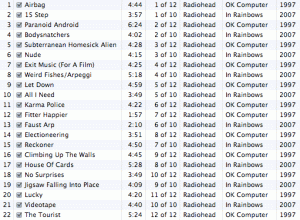
I’m listening to the Radiohead 01 and 10 playlist. The conspiracy theory behind the mashup between OK Computer and In Rainbows is an internet legend and actually rather compelling. I don’t really buy it, though. It’s not really amazing that the earlier album complements the latter in sound and message. I do accept the rather pleasing decaphilia that seems to pervade In Rainbows but I simply don’t believe that the two albums were ever meant to be heard together. The fact that they sound awesome together is all the more wonderful, then.

I first listened to the playlist without the 10-second crossfade recommended by some of the initiated. I figured that a band like Radiohead, who famously eschewed their record label and feel ambivalent at best towards the idea of corporations etc., would design something that required an iTunes feature to be fully appreciated. (Insert your preferred proprietary software if you like, but you get my point.) I’m listening to the crossfaded version as I write this. Alarm bells ring for me when the lovely, fitting, shudder-to-a-halt ending of ‘Paranoid Android’ is obliterated by the next track starting. It’s just not an enhancement of the art. Other segues between the tracks just sound like crossfades to me. Adjacent songs are in different keys and my ear recoils a little when they’re mashed together.

It’s a great, great idea, however, and I’m looking forward to a day when a band releases an album that does sound coherent when the tracks are rearranged and crossfaded in a particular way. That’ll be exciting; this playlist ain’t it, though.

What the 01 and 10 playlist does demonstrate, though, is the remarkable music of the Oxford band called Radiohead. Listening to the tracks in an unfamiliar order, harkening closely to the ending of one track and the beginning of another, attending to the lyrics, amazed me anew at the gift to the world that their music represents. Complex, yet often irresistably danceable (yes, I’m listening to Weird Fishes/Arpeggi at this moment…), sometimes heartbreaking, sometimes joyous.

My main aural observation was that the guitar lines are absolutely vital to what makes the songs brilliant. (More so in OK Computer – the interim period of experimentation saw the band explore a wider palette of instrumental possibilities.) The music, especially on the later album, is often truly contrapuntal, instruments and voice(s) twisting together without a reliance on chordal parts to underpin the texture. (It’s interesting that one of their most chordal songs, ‘Karma Police’, disintegrates into the unforgettably chilling ‘Fitter Happier’, almost as if they already knew at that stage that such songs were no longer going to be possible as their musical horizons expanded.) I’ve always especially loved ‘Electioneering’ from OK Computer, and it was listening to the fretboard-spanning guitar line that runs through the chorus that really alerted me to how important such discernable, often singable parts were to the band’s sound and musical vision.

So, my recommendation: read (a bit) about the idea behind it, put together the 01 and 10 playlist (sans crossfade), plug in a good pair of headphones and enjoy the music of one of the world’s very best bands from a fresh perspective. Then let me know what you heard.

The King’s Speech

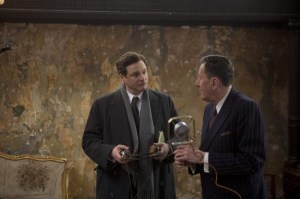
Colin Firth and Geoffrey Rush in 'The King's Speech'

I really enjoyed this film – we watched it today in the swanky Palace Brighton Bay cinema. It was interesting to watch it in Australia, having spent half a year here now. There are lots of amiable nods to Australia in the film (Lionel Logue, the speech therapist who helped King George VI and who is portrayed wonderfully by Geoffrey Rush in the film, was Australian).

The music in the film is rather prominent and matches the large-scale story well. To accompany Bertie’s first session with the antipodean therapist – as he roars the “To be or not to be” speech – it is Mozart’s ‘Marriage of Figaro’ overture that is blasted into his headphones to prevent him hearing himself. At the climax of the film – when the now King, George VI, is broadcasting his “In this grave hour” speech to his nation and empire – it is that most regal of music, Beethoven’s seventh symphonic slow movement, that provides the backdrop for the weighty words.

This seems to me a well considered and appropriate use of music. A noticeable part of the film’s ‘look’ was in recreating the clean, sparse furnishings of the time (and I mean furnishings in the widest sense: the clothes and the civic spaces as well as the dwelling decoration all harked back to a less cluttered time). Music composed especially and therefore unknown would have seemed trite and perhaps hackneyed in the context of such an aesthetic. As it was, the familiarity of the music gave it both a suitable gravitas and a cultural transparency.

It was the pitch-perfectness of these moments that allowed the film’s real charm and mischevious humour to shine all the brighter.

U2

I tweeted on Friday that I’d be busking a U2 song. The Irish band (THE Irish band?) were in town this week to play dates on their 360° tour at the Etihad stadium. I brushed off ‘Where The Streets Have No Name’ that morning and went into town, eventually getting a spot in the Flinders Street station subway at rush hour to sing it on repeat for the passers-by. And very satisfying to sing it is, too! I took it down a couple of semitones to suit my range and had a great time belting out what must certainly be the archetypal U2 song: euphoric, defiant, numinous.

Imagine my surprise, then, dear reader when Jenny and her friend Ulla appeared in the tunnel complaining that I hadn’t been answering my phone (or checking my voicemail, or texts, or facebook, or Twitter…!) and could I please stop now because we had tickets for the gig! They headed off to hear Jay-Z’s support slot and I dashed home to drop off the guitar and have a quick shower.

The Etihad stadium is big – it holds over fifty-six thousand people – and it was amazing to be part of the crowd for the impressive show that the band put on. The stage was a marvel to behold – literally a spaceship with the wonderful screens that have surely revolutionised the stadium concert experience.

The most impressive element of the production for me was The Edge. Bono lauded his remarkable gifts when he did his introductions of the band members, but, just as he didn’t have to say anything about himself, the gifts of the guitarist were self-evident. The moment when my jaw dropped at his talents was the coda of ‘Stuck In A Moment You Can’t Get Out Of’. The song was poignantly introduced as a paean to their sadly departed friend, Michael Hutchence (whose absence has been evident here in recent weeks, as the band he fronted continue with other singers), and Bono and The Edge did the song themselves, accompanied simply by Edge’s acoustic guitar. The coda section features The Edge on backing vocals (“…and if the night runs over, and if the day won’t last…”) and his falsetto was bang-on, powerful and assured. Another impressive Edge moment was in ‘New Year’s Day’: he plays the piano riff and then launches into the guitar solo that he’s played pretty much every night for thirty years. It’s the musical equivalent of Martin Luther King calling out the words of the old negro spiritual at the end of his “I have a dream” speech. (I don’t mean that every time they play it it’s a moment of great historical significance that draws on the familiar to harness the now…but that it feels just like one.)

IMG_9063

Cruciverbalism

My subscription to the New York Times crossword app expired today so, rather than furrowing my brow over that on the train today, I thought I’d use the time to blog. The NYT crossword is published every day – Monday is the easiest and they get more difficult each day until Sunday’s larger, themed puzzle. I can usually do Monday and Tuesday without help, but the later part of the week usually leads to a good deal of head-scratching on my part. Couldn’t recommend it highly enough. After all, who doesn’t like having their head scratched?!

So, if you enjoy crosswords and have an iSomething, go get the app. And when you get stuck, go and find Rex Parker – a terribly clever person whose blog about the crossword is what I turn to in times of extreme trichotilomania.

The Mornington Singers

I went to a concert last night by our choral neighbours, The Mornington Singers. They are conducted by the lovely Orla Flanagan and sang in the marvellous Pro-Cathedral in Dublin.

It was my first time in the cathedral (the Catholic one…not sure why it gets the positivity prefix…) and it really is quite nice indeed. Not too over-the-top in terms of gold and such, but there are two domes in the roof and a large area around the altar that lended itself perfectly to the choir’s arched formation. (Note to self: do I mean ‘arced’? Looks wrong.) The building reminded me of St Cecilia’s Hall in Edinburgh, one of the concert rooms built in Georgian times. Of course, the cathedral is bigger and more, well, ‘churchy’, but it did seem to yearn for ancient Greece or Rome in the way that the Georgian architects favoured.

The programme for the evening was titled ‘A Midsummer Night’s Dream’ but, apart from Veljo Tormis’s ‘St John’s Day Songs’, this was less a theme and more an apt description of the evening’s experience.

The concert opened with two pieces by James MacMillan: ‘A Child’s Prayer’ and ‘The Gallant Weaver’. I wondered about opening with the first of these. It does begin with the word “welcome” but it is an intense piece and I wasn’t sure I was ready to hear it straight off. It’s a great sing for the two soprano soloists, whose intertwining lines gracefully float over the sonorous repeated chords of the choir. The middle section flickers with ornamented notes in all parts on the word “joy” and propels the music upward to the final, heart-breaking duet.

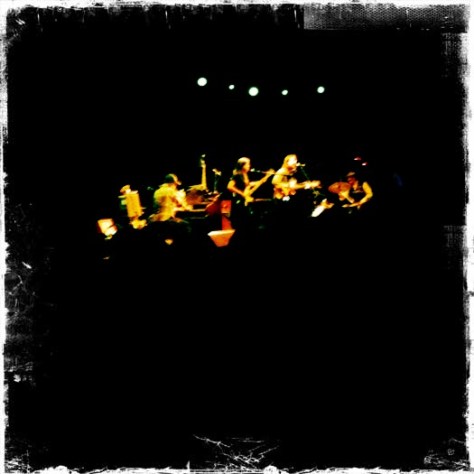
The Low Anthem – Vicar Street, Dublin 8jan10

My friend Brian recommended The Low Anthem to me a few weeks ago and lent me ‘Oh My God, Charlie Darwin’. It’s a mix of beautiful and barnstorming folk and I hadn’t even listened to the whole thing when I noticed, entered, and WON! a ticket competition in the last edition of Le Cool. Le Cool is a great e-zine that highlights interesting things happening in the city* every week. Or, as they more eloquently put it, “a free weekly cultural agenda and alternative city guide”. It works really well on the iPhone, too, with the pages sliding over to the side.

* It’s published for Barcelona, Madrid, Lisboa, London, Istanbul, Moscow, and Budapest, too.

The gig was in Vicar Street, having been moved from Whelan’s due to a large demand for tickets. The whole ground floor of Vicar Street was packed with 20s/30s cool people and older cool people. There were beards and checked shirts in abundance. We had our customary Jameson & Cokes in the bar. I thought it was more of a longneck beer night, but Brian has a predilection for that particular combo which wouldn’t be staved off and I joined him for auld lang syne. It’s a while since we saw each other and so we managed to miss the support act but we wandered into the main venue shortly after nine and contemplated where it would be best to stand. Having found the perfect spot that managed to suit our very different physicalities, we awaited the band’s arrival on stage. Tom Waits played over the PA system…

Photo taken using Hipstamatic iPhone app

At about twenty-five past nine they came on, looking just right. The lead singer said they’d be playing three types of songs: songs from ‘Oh My God, Charlie Darwin’, some new songs they’d been working on for the past six weeks, and some old American songs. I’m afraid I didn’t even bother trying to keep a setlist because I don’t know any of the titles and figured I’d have a hard time finding the names of two-thirds of the set anyway. Plus, it’s pretty nerdy to be tapping away on the iPhone during the gig!

It was all pretty chilled out for the first handful of songs and we were treated to the beautiful array of sounds they had brought to play for us: an old reed organ sat on the left of the stage; an upright bass, an electric guitar (Fender Mustang, maybe…?), a less-than-full-size acoustic; a lovely bits-and-pieces drum kit which comprised a proper marching bass drum, a snare drum, high hi-hats that wobbled about satisfyingly when they were played, and two great-sounding cymbals. In one of the early songs, a home-made shaker was produced. The girl interested me most (yeah, yeah, settle down…) as she played clarinet, bass guitar, electric guitar, sang, and played a set of crotales with a bow. Generally doing the kind of multi-instrumental shenanigans that I do 🙂 Her clarinet tone was lovely and I really liked the way she played – using a wide vibrato for the slower, more sonorous songs, rising up on her toes slightly for the higher notes, not shying away from some lovely high lines up at the top end of the instrument’s register… In one of the last songs she and the reed organ player did some sweet harmonies, the sounds blending beautifully, as you’d expect.

When they let rip (on tracks like ‘The Horizon Is A Beltway’), we were riveted for a completely different reason. I was really drawn in by their committed, raw performances. One of the stand-out songs was something about whiskey and women driving you insane (sorry, rubbish not to have a title, I know…!) and on each climax of the chorus they held a chord for *just* a bit longer, the girl going up to the next harmony until they literally couldn’t hold it any more. It’s this kind of thing that makes a live performance trump a recording every time. (If the artists are prepared to take those risks…)

Another lovely moment was in a song where three of the four musicians played wind instruments: the girl’s clarinet being augmented by another and also by a brass band-style horn (i.e. not a French horn). On the last horn break the singer took out two phones (he’d tried to explain this to us, but we didn’t really get it until he did it). He called one with the other and put them on speaker, whistling into them, causing feedback. It made a ghostly, theremin-like noise throughout the crowd (some people had copped on what to do…).

This person got some really good footage from up near the stage. On this song, ‘This God Damn House’, you can hear that lovely clarinet vibrato and then the mobile phone thing from 3’56”.

Here’s a clip of ‘Cage The Songbird’ that I recorded. You can hear the bowed crotales well from about 0’22”.

Here is Damien McGlynn’s review and much better photos than mine, from state.ie.

Question:

  • Since you all change instruments so much, how do you decide who plays what in each song?